Best Immersion and Hybrid Brewers
Every manual brewer makes you choose between two things you want. A French press steeps the coffee for you and forgives almost everything, but its metal mesh sends oils and fines into the cup. A pour-over cone gives you a clean, bright cup, and gives it only if you pour well. Immersion and hybrid brewers exist to refuse that choice: the coffee steeps in a sealed chamber like a press, then a valve opens and the whole brew drains through a paper filter. You get the forgiveness of steeping and the clarity of paper in the same cup, and the only technique required is a timer. We compared the brewers most consistently recommended by home brewers on valve design, filter availability and cost, drawdown behaviour, capacity and cleaning, and what owners report after years rather than weeks.
As an Amazon Associate, Cafe & Crema earns from qualifying purchases. This never affects the price you pay. How we make money.
| Rank | Product | Score | Best for | Link |
|---|---|---|---|---|
| #1 | Clever Coffee Dripper, Large 18 oz, Clear, with 100 FiltersTop pick | 9.2 | Anyone who wants clean, filtered coffee without learning to pour | Check price → |
| #2 | Hario V60 Switch Immersion Dripper, Size 02, Glass and SiliconeBest hybrid | 9.2 | People who already brew pour-over and want steeping as a second mode rather than a replacement | Check price → |
| #3 | Bonavita BV4000IDV2 Wide Base Porcelain Immersion DripperBest flat bed | 8.6 | Immersion brewing on a counter, where heat retention and looks both matter | Check price → |
| #4 | Delter Coffee Press, 400ml, TransparentBest for travel | 8.8 | Travel, and brewers who want to control extraction rather than let it happen | Check price → |
| #5 | Hario V60 Switch Immersion Dripper, Size 03Best for two | 9.0 | Households where two people want clean immersion coffee at the same time | Check price → |
#1 · Our PickTop pick
Clever Coffee Dripper, Large 18 oz, Clear, with 100 Filters
Best for: Anyone who wants clean, filtered coffee without learning to pour
What we like
- The simplest possible version of the idea, and it works exactly as advertised
- Takes ordinary Melitta #4 filters sold in every supermarket
- Valve opens automatically when you set it on a mug or carafe — nothing to remember
- 18 oz brews a large mug or two small cups
- Almost impossible to brew badly with, which is the entire point
What we don't
- Plastic, and it looks it next to ceramic or glass
- The silicone valve seal is the part that eventually wears
- Tall enough that it does not fit under every kettle spout or on every mug
- No way to open the valve early, so hybrid recipes are off the menu
- Stains over years like all clear plastic that meets coffee
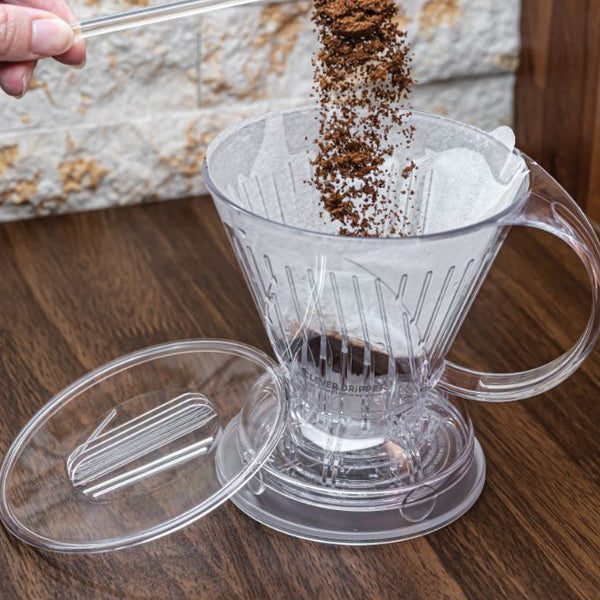
The Clever is a plastic cone with a spring-loaded valve in the base, and that is the whole invention. Grounds and water go in, a lid goes on, four minutes pass, and you set it on your mug — the mug's rim pushes the valve open and the brew drains through the paper. Nothing about the process rewards skill, which is precisely why it produces such consistent coffee. The variables that decide the cup are dose, water temperature and time, all of which you can read off a scale and a clock rather than feel in your wrist.
What makes it the default recommendation rather than merely a good one is the filter. It takes flat-bottomed Melitta #4 papers, which sit on a supermarket shelf next to the coffee and cost almost nothing. Several brewers in this category are excellent and then quietly require a specialist consumable ordered online; this one does not, and over a few years that difference is larger than any difference in the cup.
The honest limits are material and flexibility. It is plastic — durable, unbreakable, dishwasher-safe on the top rack, and not an object anyone displays. The silicone seal around the valve is the wear part and will eventually weep, though that takes years of daily use. And because the valve only opens when the brewer is set down, you cannot release part of the brew mid-steep the way a lever-operated hybrid allows, so the more elaborate two-stage recipes are unavailable. For a brewer whose appeal is that it removes decisions, that is not much of a loss.
The brewer to buy first in this category and probably the one to keep. Cheap, supermarket filters, and a cup that is hard to get wrong.
Check price on Amazon →#2Best hybrid
Hario V60 Switch Immersion Dripper, Size 02, Glass and Silicone
Best for: People who already brew pour-over and want steeping as a second mode rather than a replacement
What we like
- The only brewer here that does both jobs — full immersion, ordinary pour-over, or a recipe that switches between them
- Manual lever means you decide when the bed drains, not the mug
- Uses standard V60 02 papers, which are cheap and stocked everywhere
- Heatproof glass cone on a silicone base, and it looks like something you leave out
- Every published V60 recipe works in it unchanged with the switch left open
What we don't
- Costs several times what a Clever does for a cup that is often indistinguishable
- Glass, so it breaks, and the steel ball valve needs care when washing
- Small — 02 is one mug, not two
- The hybrid recipes it enables are genuinely fiddly to follow
- Needs preheating like any glass or ceramic cone
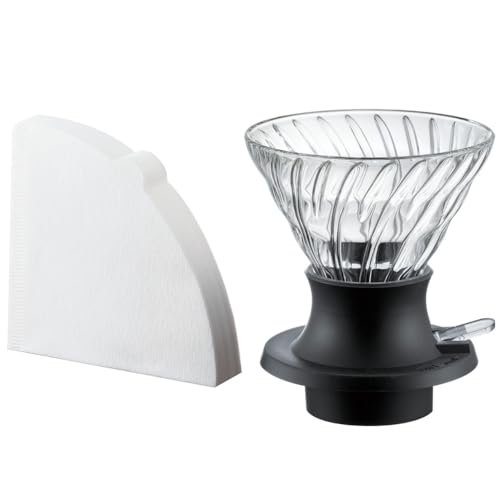
The Switch is a V60 cone sitting in a silicone base that holds a steel ball against the outlet. Flick the lever and the ball drops, and the brewer is an ordinary V60. Leave it closed, fill it, wait, and it is an immersion brewer. That dual identity is the point, and it is the only brewer here that has it: if you own a V60 and follow published recipes, every one of them still works, and you gain a second mode for the mornings when you would rather not stand over a kettle.
What that unlocks is the two-stage recipe, in which part of the water steeps with the valve closed and the rest is poured through with it open. Done well, this gives you the body and forgiveness of immersion with the brightness of percolation, and it is the reason competition brewers took the Switch seriously. Done casually, it produces exactly the same cup as the Clever for several times the money — worth saying plainly, because the marketing implies otherwise.
Practically, it is glass on silicone, so it needs preheating and it breaks, and the ball valve is a small loose-ish part that deserves attention when washing. Size 02 is a single mug rather than a pot. Filters are ordinary V60 papers, which is a real advantage over anything needing a proprietary consumable. If you want one brewer and want it to be easy, this is not it. If you want the brewer with the most recipes available to it, it is comfortably the best on this page.
The most capable brewer on this page and the least necessary. Buy it because you want to play with two-stage recipes, not because it makes a cleaner cup than a Clever.
Check price on Amazon →#3Best flat bed
Bonavita BV4000IDV2 Wide Base Porcelain Immersion Dripper
Best for: Immersion brewing on a counter, where heat retention and looks both matter
What we like
- Porcelain holds heat far better than plastic through a four-minute steep
- Wide flat base gives a level bed and an even drawdown
- Takes supermarket Melitta #4 filters
- Marked open/close slider means the drawdown starts when you decide, not when you set it down
- Lid keeps temperature up while steeping and doubles as a coaster afterwards
What we don't
- Heavier and more fragile than every plastic brewer here
- The slider valve is manual, so a forgotten brewer drips onto the counter
- Smaller capacity than the large Clever
- Porcelain must be preheated or it steals heat from the brew
- Harder to find in stock than the more common brewers
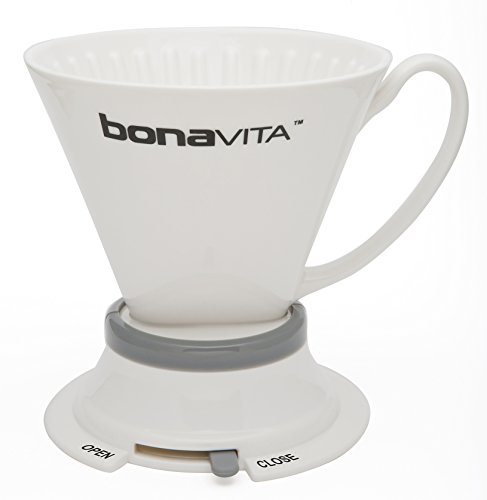
This is the Clever's idea in glazed porcelain with a wide flat bottom and one mechanical difference: the valve is a marked slider on the base that you push from close to open yourself, rather than a spring released by the rim of a mug. In practice that puts it between the two designs — the forgiving single-mode brewing of a Clever, with the drawdown timing of a lever. The two differences that matter in the cup are heat and bed shape. Porcelain preheated with a rinse holds temperature through a four-minute steep noticeably better than thin plastic does, and in immersion brewing, where the water sits still rather than moving through, that thermal drop is one of the few variables you can actually control. The wide base gives a shallower, more level coffee bed, which drains evenly when the valve opens.
In the cup, the effect is a slightly rounder, fuller brew than the same coffee in a plastic immersion dripper, though the gap is smaller than the price difference suggests. It takes the same cheap #4 papers, and the lid does real work: it holds the steam in during the steep and gives you somewhere to put a dripping brewer afterwards.
The costs are the obvious ones. It is porcelain, so it is heavy, it breaks, and it must be preheated to be worth its advantage. It holds less than the large Clever, so it is a one-mug brewer. And a manual slider is a manual slider: leave it open by mistake and the brew runs onto the counter instead of steeping, which is a failure mode a contact-opened valve makes impossible. If it fits your kitchen, it is the nicest way to brew this style of coffee.
The Clever's idea executed in porcelain. Better heat retention and a nicer object, at the cost of weight, fragility and capacity.
Check price on Amazon →#4Best for travel
Delter Coffee Press, 400ml, Transparent
Best for: Travel, and brewers who want to control extraction rather than let it happen
What we like
- Injection brewing gives more control over contact time than any brewer here
- No agitation at all, which produces an unusually clean cup without a thick filter
- Sealed plastic body that survives a rucksack better than anything glass
- Paper filters are small, cheap and easy to carry
- Brews concentrate or a full cup depending on how you press
What we don't
- Not actually an immersion brewer, which makes it the odd one out on this page
- The dosing and pressing routine has a real learning curve
- Small capacity, and pressing takes attention rather than a timer
- More parts to disassemble and dry than a simple dripper
- Little published recipe support compared with a V60 or an AeroPress
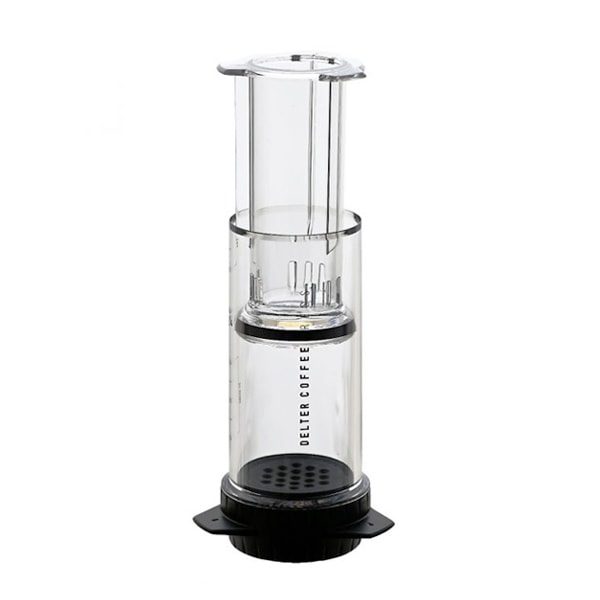
The Delter belongs on this page by category rather than by mechanism. It does not steep. Water sits in a separate chamber and is injected through the coffee bed by the plunger, at a rate you set with your hand, without the grounds ever being stirred. The result is a cup with the clarity people associate with a well-rinsed paper filter and a body closer to a press — achieved by controlling flow rather than by controlling time.
What that gives you is unusual control. Press slowly for a longer contact time and a heavier extraction, quickly for something lighter and brighter, or press only part of the water for a concentrate to dilute. It is also, by a distance, the best travel brewer here: a sealed plastic body with no glass, no ceramic, and filters small enough to carry a hundred of.
The price is effort. Dosing, seating the chamber and pressing at a consistent rate take practice, and the first several brews will be inconsistent in a way the Clever's never are. There are more parts to rinse and dry. And the recipe ecosystem around it is thin compared with the brewers everyone owns, so you will be working things out rather than following instructions. Buy it if that appeals or if it is going in a bag; buy something else if you want a brewer that works while you make toast.
The outlier here: it presses water through the coffee rather than steeping it. Excellent, portable, and the only brewer on this page that demands technique.
Check price on Amazon →#5Best for two
Hario V60 Switch Immersion Dripper, Size 03
Best for: Households where two people want clean immersion coffee at the same time
What we like
- Brews enough for two mugs or one large carafe in a single steep
- Same lever valve and dual-mode capability as the 02
- Takes standard V60 03 papers
- The extra headroom makes two-stage recipes much easier to pour
- Doubles as a full-size pour-over cone with the switch left open
What we don't
- Overkill and slightly awkward for a single small cup
- The same money buys two large Clever drippers
- Glass and silicone, so the fragility and the ball valve come with it
- 03 filters are stocked less widely than 02
- Larger doses need a proportionally larger grinder session
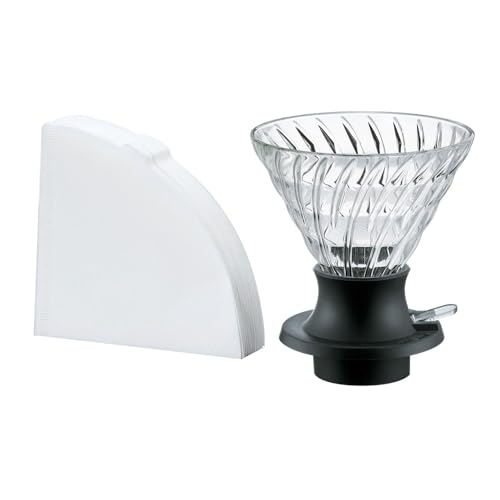
Capacity is the quiet limitation of this whole category. Most immersion drippers make one mug, and making a second means brewing again, which is exactly the friction that pushes people back towards a French press or a drip machine. The 03 Switch is the straightforward fix: the same cone, the same lever valve, the same modes, sized for roughly twice as much coffee.
The extra volume is more useful than a capacity number suggests. Two-stage recipes involve pouring into a chamber that already holds water, and the 02's headroom makes that a careful operation; the 03 simply has more room to work in. With the switch left open it is also a perfectly ordinary size 03 V60, so it covers the batch pour-over job as well.
The reasons to think twice are money and scale. It costs several times what the large Clever does and brews a similar amount, and 03 papers are stocked in fewer places than 02. Brewing single small cups in it is possible but awkward, since a shallow bed in a wide cone drains fast. If two cups at once is your actual daily requirement, this is the right buy; if it is an occasional one, the large Clever handles it for far less.
The Switch scaled up, and the answer if the single-mug capacity of everything else on this page is the problem.
Check price on Amazon →Immersion and hybrid brewers all exist to solve the same annoyance: the two things that make coffee taste the way you want are steeping and paper, and until recently you had to pick one.
A French press steeps, which is why it forgives an inattentive morning, and strains through metal, which is why the cup is heavy and slightly silty. A pour-over cone filters through paper, which is why the cup is clean and bright, and percolates, which is why a careless pour ruins it. Put a valve in the bottom of a paper-filtered cone and you get both halves: the coffee steeps like a press, then drains like a pour-over.
What the valve actually changes
In a pour-over, water is passing through the coffee the entire time you are pouring, so the pour is the brew. Pour too fast and the water leaves before it has taken enough; pour unevenly and part of the bed is over-extracted while another part is barely touched. That is why pour-over rewards practice.
Close a valve underneath and none of that applies. The water sits in contact with every ground at once, for as long as the clock says, and then leaves. There is no pour to get wrong. The only variables left are dose, temperature, grind and time — all of which are numbers rather than skills.
What you keep is the paper. Oils and fines stay in the filter rather than the cup, which is where the clarity comes from. That combination — a press’s forgiveness with a filter’s clean cup — is the whole category.
Automatic valve or manual lever
There are two designs and the difference is more practical than it looks.
Contact-opened valves — the Clever — are held shut by a spring and pushed open by the rim of the mug you set the brewer on. You cannot forget to open it, and you cannot open it early. It will sit on the counter steeping indefinitely without dripping.
Manual valves — the Hario Switch’s lever, the Bonavita’s marked slider — put the timing in your hand. On the Switch that is the prerequisite for two-stage recipes, where some of the water steeps closed and the rest is poured through open. On both, it is also one more thing to remember, and a valve left open drains onto the counter rather than steeping.
If you want the elaborate recipes, buy the lever. If you want coffee, the automatic valve is one fewer decision every morning and costs considerably less.
The filter question decides more than the brewer
Everything in this category is separated by paper, and the paper is the recurring cost.
Clever and Bonavita drippers take Melitta #4 filters — the flat-bottomed papers sold next to the coffee in any supermarket, at a price low enough not to think about. The Hario Switch takes standard V60 papers, cheap and widely stocked, though the 03 size is carried in fewer places than the 02. The Delter takes its own small discs, which are inexpensive but must be ordered.
A brewer whose consumable is inconvenient is a brewer that ends up in a cupboard. This is worth more attention than the material of the cone.
Grind still matters, in one specific way
Immersion is forgiving of pouring. It is not forgiving of grinding, and people are surprised by this.
During the steep, grind barely matters — everything is submerged either way. It matters at the drawdown. Open the valve on a bed of too-fine coffee and it chokes, so the brew that was supposed to end at four minutes is still sitting in water at seven, extracting the whole time. The result is exactly the bitterness the method was supposed to prevent.
The fix is coarser, not shorter. Aim for something around table salt, and if the drawdown takes much over a minute, go coarser before changing anything else. How grind size behaves is the same story here as everywhere: consistency is what you are buying.
Which to buy
If you want clean, filtered coffee without learning to pour, buy the large Clever and stop reading. It is the cheapest thing here, it uses supermarket filters, and the cup is genuinely hard to distinguish from the brewers costing several times more.
If you already brew pour-over and want a second mode rather than a replacement, the Hario Switch is the only brewer here that gives you both, and every V60 recipe you know still works in it.
If two people want coffee at once, the 03 Switch or the large Clever, in that order of capability and reverse order of price.
If it is going in a bag, the Delter — the only brewer here with no glass, no ceramic and nothing to break.
And if you are still deciding whether this style of brewing suits you at all, the underlying variables are the same ones that govern every filter method. Ratios, grind and technique covers what each of them does, and most of it applies here with the pouring removed.
Frequently asked questions
What is the difference between an immersion dripper and a French press?
The filter, and everything that follows from it. Both steep coffee in hot water for several minutes, so both are equally forgiving of technique. A French press then separates the grounds with a metal mesh, which lets oils and fine particles through and gives the cup its heavy, slightly silty body. An immersion dripper drains the whole brew through a paper filter instead, which catches those oils and fines and produces a clean, clear cup much closer to a pour-over. Same brewing, different separation, genuinely different drink.
Is a hybrid brewer better than a V60?
It is more forgiving, not better. A V60 rewards a careful, well-paced pour and punishes a rushed one, so its best cup is higher and its worst is lower. An immersion or hybrid brewer takes the pour out of the equation almost entirely — the coffee steeps whether you concentrate or not — which narrows the range between your good and bad mornings. If you enjoy the ritual and want technique to matter, the V60 is the better brewer. If you want the same clean cup every day without thinking, this category is.
Do these brewers need a gooseneck kettle?
No, and that is one of their main practical advantages. Because the coffee steeps rather than being poured through a bed, water placement does not matter — you can fill a Clever or a Switch from any kettle or even a tap of near-boiling water. This is why an immersion dripper is often the more sensible first pour-over-style brewer: it removes a piece of equipment from the shopping list rather than adding one.
What grind should I use?
Medium, roughly the texture of table salt, which is finer than French press and coarser than a V60. The steep is forgiving of grind, but the drawdown is not: too fine and the bed chokes when the valve opens, leaving the coffee sitting in water for far longer than intended and turning it bitter. If your brews take much more than a minute to drain, grind coarser before changing anything else. Consistency matters more than the exact setting, which is the usual argument for a burr grinder.
How long should I steep?
Between two and four minutes for most coffees at a medium grind, with three as a sensible starting point, then let it drain. Because contact time is the main variable you control, it is also the one to adjust: a thin, sour cup wants longer or finer, a harsh, bitter one wants shorter or coarser. Change one of those at a time. Unlike pour-over, the clock is genuinely doing the work here, so a timer is more useful than any other accessory.
Can I use these for tea?
Yes, and they are unusually good at it. A brewer that steeps loose leaf and then drains it through paper at a moment you choose is exactly what tea wants, and it avoids the over-steeping that happens when leaves sit in a pot. Use a coarser grind of leaf than you would for coffee — which is to say, leave it whole — and rinse the brewer properly afterwards, since tea tannins and coffee oils both linger.
Do the paper filters need rinsing first?
Yes for anything thick, and it costs nothing to do it always. A dry paper filter contributes a faint papery taste to the first part of the brew, and rinsing with hot water removes it while also preheating the brewer, which is the more valuable half of the habit with ceramic or glass. Discard the rinse water before adding coffee. With thin standard papers the difference is small; with thicker ones it is obvious.
How do I clean the valve?
Rinse it under hot water after every brew and take it apart properly every few weeks. The valve seal is where coffee oil accumulates on every brewer in this category, and a gummed seal is the usual reason an immersion dripper starts weeping during the steep. On the Hario Switch, that means removing the silicone base and washing the steel ball separately; on a Clever or Bonavita, running hot water through the open valve and occasionally scrubbing the seat with a soft brush. None of them tolerate a dishwasher's bottom rack.