Best Reusable Pods and Capsule Filters
A pod machine is a brewer that has been sold to you along with a subscription you never signed. The machine was the cheap part; the capsules are where the money goes, and they arrive wrapped in plastic and foil that almost nothing recycles. A reusable pod removes both problems at once — you fill it with whatever coffee you like, brew, empty it and use it again — and it introduces one new variable, which is that you are now responsible for the grind that the capsule factory used to get right. We compared the refillable pods and filter inserts most consistently recommended by owners on machine compatibility, seal quality, grind tolerance, cleaning effort and how well they hold up after months rather than weeks, and we have been explicit about the one popular system where refilling still does not really work.
As an Amazon Associate, Cafe & Crema earns from qualifying purchases. This never affects the price you pay. How we make money.
| Rank | Product | Score | Best for | Link |
|---|---|---|---|---|
| #1 | Keurig My K-Cup Universal Reusable Coffee Filter, MultiStream TechnologyTop pick | 8.8 | Anyone with a current Keurig who wants to stop buying capsules | Check price → |
| #2 | SEALPOD Reusable Capsules for Nespresso Original, 2 Stainless Steel Pods with 100 Foil LidsBest for Nespresso Original | 8.2 | Nespresso Original owners who want to choose their own coffee and are willing to work for it | Check price → |
| #3 | Perfect Pod EZ-Cup 2.0 Reusable K-Cup Pod with 25 Disposable Paper FiltersEasiest to clean | 8.6 | People whose real objection to reusable pods is the washing-up | Check price → |
| #4 | Keurig My K-Cup Universal Reusable Filter, Keurig Classic and 1.0 SeriesFor older Keurigs | 8.8 | Keurig Classic and 1.0 owners, where the current filter simply will not seat | Check price → |
| #5 | Ekobrew Paper Filters for Reusable K-Cups, 300 CountBest consumable | 9.0 | Anyone who already owns a reusable pod and is tired of scrubbing mesh | Check price → |
#1 · Our PickTop pick
Keurig My K-Cup Universal Reusable Coffee Filter, MultiStream Technology
Best for: Anyone with a current Keurig who wants to stop buying capsules
What we like
- Made by Keurig, so it fits current machines properly and does not void anything
- Mesh basket and lid are dishwasher-safe, which is most of the daily objection dealt with
- Fill line is marked, so dosing is repeatable without a scale
- Works across the current K-Cup range rather than one model
- Takes optional paper inserts if you want a cleaner cup
What we don't
- Not compatible with older Keurig Classic and 1.0 brewers — check before buying
- Mesh lets fine particles through, so there is sediment unless you add paper
- Plastic and mesh both stain over time
- Fiddly to fill neatly without spilling grounds into the machine
- Adds a rinse to a routine people chose specifically to avoid rinsing
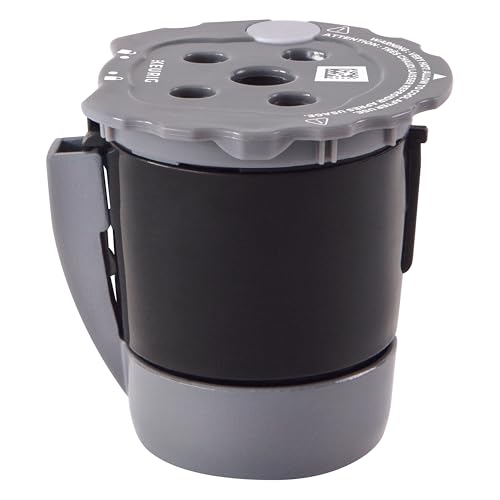
This is the manufacturer's own reusable filter for the current generation of machines, and buying the official one solves a problem that costs the third-party market a lot of returns: fit. Reusable baskets have to seat correctly against the needle and the holder, and a millimetre out means either a bypassed brew that tastes of hot water or grounds forced past the seal into the machine. Keurig's own part fits Keurig's own machines. That is unglamorous and it is the main reason to buy it.
In use, it is straightforward. Fill to the marked line — around a tablespoon and a half of medium-ground coffee for a standard cup — seat it, brew as normal. The mesh basket and lid go in the dishwasher, which removes most of the daily friction. The cup it produces is a genuine improvement over a supermarket capsule if you fill it with fresh coffee, and no better than one if you fill it with something that has been open for a month.
Two honest limitations. The mesh passes fines, so the last mouthful carries sediment unless you drop a paper insert in, and the fit that makes it good is also version-specific: this is the MultiStream-era part, and it does not fit the older Classic and 1.0 brewers. Check which machine you own before ordering, because the two Keurig filters look almost identical in photographs and are not interchangeable.
The default answer for a modern Keurig. Official, dishwasher-safe, and it fits — which is more than can be said for most of the alternatives.
Check price on Amazon →#2Best for Nespresso Original
SEALPOD Reusable Capsules for Nespresso Original, 2 Stainless Steel Pods with 100 Foil Lids
Best for: Nespresso Original owners who want to choose their own coffee and are willing to work for it
What we like
- Stainless steel body that survives being pierced and cleaned indefinitely
- Foil lids let the capsule pressurise properly, which mesh-only refillables cannot do
- Genuinely produces espresso with crema rather than the flat brown liquid most refills give
- Works across the Nespresso Original range including third-party machines
- Two pods is enough to keep a rhythm going without washing between shots
What we don't
- The foil lids are a consumable, so this reduces waste rather than eliminating it
- Needs a fine, even grind and a real tamp — a blade grinder will not do
- Fiddly: dose, tamp, seal, brew, prise out, wash, repeat
- Original line only; it will not work in a Vertuo machine
- Steeper learning curve than any other product here
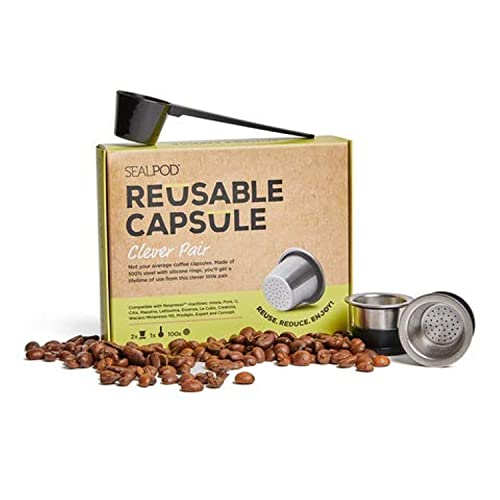
Nespresso Original is a pressure system, and that is why most refillable Nespresso pods disappoint. The machine drives water at high pressure through a sealed capsule, and the seal is doing structural work: it holds back-pressure until it ruptures against the plate, which is what extracts the shot and builds the crema. An open mesh capsule has nothing to hold, so the water passes through quickly and you get weak, crema-free coffee that tastes like a failure of the machine.
Sealpod addresses that directly with a stainless body and a self-adhesive foil lid per shot. The lid restores the seal, the capsule pressurises, and the result is recognisably espresso. The trade is that a lid is consumed each time, so this is a large reduction in waste rather than an elimination of it, and the pods themselves last effectively forever.
What it demands is technique. The grind has to be fine and even — espresso-fine, not filter — and the dose must be tamped, or the water finds a channel and the shot runs thin. That means a decent burr grinder is a prerequisite, and it means the first several attempts will be worse than the capsules you were buying. If that sounds like a project, it is the right buy. If you want to press a button, it is not.
The only refillable here that actually replicates what the sealed capsule was doing. It also asks the most of you, and both of those facts come from the same place.
Check price on Amazon →#3Easiest to clean
Perfect Pod EZ-Cup 2.0 Reusable K-Cup Pod with 25 Disposable Paper Filters
Best for: People whose real objection to reusable pods is the washing-up
What we like
- The paper filter liner means emptying it is one motion into the bin
- No mesh to scrub, and no coffee oil building up in a basket
- Paper catches fines, so the cup has no sediment at all
- Filters are cheap, biodegradable and widely available
- The pod body stays clean enough that most days need only a rinse
What we don't
- The paper filters are a recurring purchase, which partly undoes the point
- Slightly smaller usable capacity than an open mesh basket
- Filter must be seated properly or grounds escape around the edge
- Plastic body rather than steel
- Two things to keep in stock instead of one
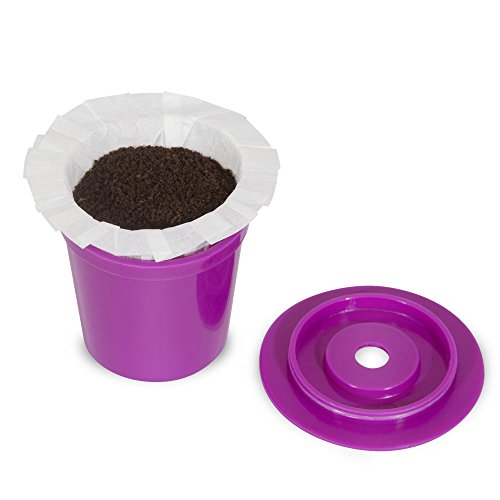
Almost everyone who abandons a reusable pod does so for the same reason, and it is not the coffee. It is standing at the sink knocking wet grounds out of a fine mesh basket every morning, which takes longer than it sounds and never quite comes clean. The EZ-Cup answers that by lining the pod with a small paper filter: coffee goes into the paper, the paper goes into the bin with the puck inside it, and the pod itself usually needs no more than a rinse.
The secondary benefit is the cup. Paper catches the fine particles that a mesh basket passes, so there is no sediment at the bottom and no accumulated coffee oil to turn rancid in a basket you rinsed but did not scrub. For a machine whose appeal is convenience, this is the version of reusability that survives contact with a weekday.
The cost is a consumable, and it is fair to notice that a system whose selling point was not buying disposable things now involves buying disposable things. They are paper rather than plastic-and-foil, they cost a fraction of a capsule, and they compost — but they are one more item on the shopping list. Seat them properly, too: a filter pushed in unevenly lets grounds past the rim, which is the one failure mode this pod has.
The reusable pod for anyone who tried one before and gave up on the cleaning. Paper does the dirty work; you throw it away.
Check price on Amazon →#4For older Keurigs
Keurig My K-Cup Universal Reusable Filter, Keurig Classic and 1.0 Series
Best for: Keurig Classic and 1.0 owners, where the current filter simply will not seat
What we like
- The correct official part for Classic and 1.0 brewers that the current filter does not fit
- Same simple mesh-and-lid design that has worked for years
- Dishwasher-safe
- Keeps a working older machine out of landfill, which is the larger environmental win
- Widely available and easy to replace
What we don't
- Explicitly not compatible with Keurig Plus and current series machines
- Mesh-only, so expect sediment without a paper insert
- Older design, and it looks it
- Same fill-and-spill fiddliness as every reusable K-Cup
- Easy to buy the wrong one of the two Keurig filters
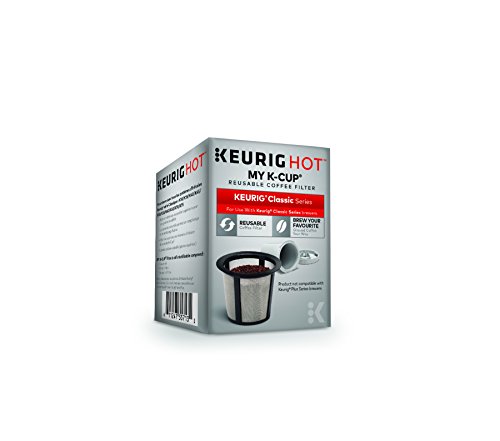
Keurig's reusable filter exists in two incompatible versions, and this is the one for the older machines. It matters because a Classic or 1.0 brewer is still perfectly good, is still on a great many counters, and cannot take the current MultiStream part. Buying the wrong one is the single most common mistake in this category, and the packaging is the only obvious difference in most listings.
Mechanically there is little to say: a fine mesh basket with a lid, a marked fill line, dishwasher-safe, seats where the K-Cup holder goes. It behaves like the newer part — the same medium grind, the same sediment if you skip a paper insert, the same rinse afterwards.
The reason to be pleased about it is unglamorous. The most environmentally significant thing anyone does with a pod machine is keep using the one they already own instead of replacing it, and a five-year-old Keurig with a reusable filter in it is a better outcome than a new machine of any kind. If your brewer is a Classic and it still works, this is the part that fits it.
Not an upgrade over the MultiStream version — the other half of a compatibility split. Buy this one if and only if your machine is a Classic or a 1.0.
Check price on Amazon →#5Best consumable
Ekobrew Paper Filters for Reusable K-Cups, 300 Count
Best for: Anyone who already owns a reusable pod and is tired of scrubbing mesh
What we like
- Turns any mesh reusable pod into a clean, sediment-free brewer
- Fits most reusable K-Cup baskets rather than one brand
- Makes emptying the pod a single motion into the bin
- Biodegradable paper rather than plastic and foil
- A large count lasts most households the better part of a year
What we don't
- Only useful if you already own a reusable pod
- Slightly reduces the amount of coffee the basket holds
- Must be seated flat or grounds bypass the paper
- Adds a recurring purchase to a system chosen to avoid them
- Removes some body along with the fines, which not everyone wants
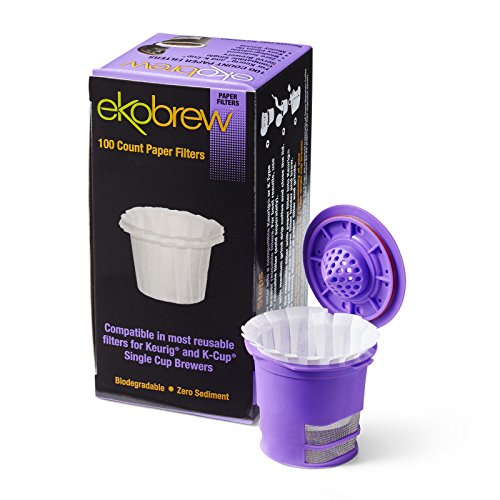
This is not a pod but the thing that makes a pod pleasant to live with. A universal paper liner drops into the basket of most reusable K-Cups, and it changes the daily experience of the system more than swapping one pod for another does. Coffee goes in the paper; the paper and the puck leave together; the basket stays broadly clean.
In the cup, the difference is sediment. Mesh baskets pass fines, and fines in a small volume of coffee are noticeable at the bottom of the mug and slightly gritty. Paper catches them. It also catches some of the oils, so the brew is cleaner and marginally lighter in body — an improvement if you disliked the murk, a small loss if body was what you were after.
The fair objection is that a reusable system now has a consumable again. The honest answer is that a paper disc is not a plastic-and-foil capsule: it costs a small fraction as much, it composts, and it does not need to be recycled through a manufacturer's scheme. Seat it flat against the basket wall so that grounds cannot slip around the rim, and it is the least expensive worthwhile thing you can add to a pod machine.
The cheapest fix on this page for the two things people dislike about reusable pods: sediment in the cup and grounds in the mesh.
Check price on Amazon →A pod machine is sold to you twice. The first sale is the machine, priced to be an easy decision. The second is every capsule you will buy for the next five years, which is where the money was always going to be — and which arrives wrapped in a plastic-and-aluminium laminate that most municipal recycling cannot separate.
A reusable pod ends both arrangements. You fill it with whatever coffee you want, brew, tip the puck into the bin and use it again. What it hands back to you is the one job the capsule factory was doing invisibly: getting the grind right.
Compatibility first, because this is where the mistakes happen
Three systems, three different answers.
Keurig is the easy one, with a catch. Keurig’s own reusable filter comes in two versions — one for current MultiStream machines and one for the older Classic and 1.0 brewers — and they are not interchangeable, despite looking nearly identical in photographs. Read the model name off your machine before ordering. Both are dishwasher-safe and both work well, because a Keurig drips water through the pod at low pressure and a plain mesh basket is entirely adequate for that.
Nespresso Original works, and needs a specific kind of pod. See below.
Nespresso Vertuo does not really work, and no amount of product design has fixed it.
Why a Nespresso refill needs a foil lid
This is the part that sinks most people’s first attempt, and it is not their fault.
An Original-line machine drives water through the capsule at high pressure. The foil lid is not packaging — it is structural. It holds that pressure until it ruptures against the piercing plate, and the resistance is what extracts the shot and builds crema. Buy an open stainless mesh capsule with a screw-on cap and there is nothing to hold pressure: the water races through, and what lands in the cup is weak, thin and flat.
A refillable that uses self-adhesive foil lids restores the seal, and with a fine grind and a real tamp it produces something recognisably like espresso. The cost is that a lid is consumed per shot, so this is a large reduction in waste rather than the end of it.
Vertuo, and why there is nothing here for it
Vertuo capsules carry a barcode around the rim. The machine reads it and uses it to set the brew volume, the spin speed and the extraction time — the capsule is telling the machine what drink to make.
A refillable Vertuo pod therefore has to present a valid barcode. In practice that means peeling the lid off a genuine capsule and reusing it, or buying lids pre-printed with someone else’s barcode, and in both cases the machine will only ever brew the one drink that barcode encodes. It can be done. It is tedious enough that we would rather say so plainly than sell you a kit, which is why the lineup above stops at Original line.
Grind is now your job
Everything that goes wrong with a reusable pod after it fits properly goes wrong here.
- Too coarse — water passes through without extracting. Thin, sour, and usually blamed on the machine.
- Too fine — the basket floods, water backs up over the rim, and grounds get into the brewer.
- Uneven — water channels through the weak spot and you get both problems in the same cup.
For a K-Cup-sized basket, aim for something around table salt and about 10 to 12 grams, filled to the marked line and left loose rather than packed. For a Nespresso refill, aim espresso-fine, about 5 to 6 grams, and tamp it properly. In both cases the grinder decides how consistent that is, and a burr grinder matters more to the result than which pod you bought.
Paper is the upgrade almost everyone eventually makes
A bare mesh basket has two annoyances: fines pass through into the cup, and wet grounds cling to the mesh so that emptying it means standing at the sink.
A paper liner fixes both. Coffee goes into the paper, the paper and the puck leave together into the bin, and the pod usually needs nothing more than a rinse. It costs a small recurring purchase, which is a fair thing to notice about a system chosen to avoid recurring purchases — but a paper disc is not a laminated capsule, it composts, and it is the difference between a reusable pod you still use in six months and one that lives in a drawer.
Which to buy
If you have a current Keurig, the official MultiStream filter, plus a box of paper liners.
If you have an older Keurig Classic or 1.0, the Classic-series filter — the current one will not seat, whatever a listing says.
If you have a Nespresso Original machine and a decent grinder, a stainless pod with foil lids. If you do not have a decent grinder, buy that first; a refillable Nespresso capsule filled with supermarket pre-ground is worse than the capsules you are replacing.
If you have a Vertuo, the honest advice is to keep buying capsules and recycle them through the manufacturer’s scheme.
And whichever you own, the thing that most affects how long the machine lasts has nothing to do with pods. Pod machines heat water, and heated water leaves scale — descaling and water maintenance is the routine that decides whether the brewer is still working when the reusable pod has paid for itself many times over. It also covers what filters and descalers are worth having, which depends on your water rather than your machine. If you are still choosing the machine itself, our roundup of pod and capsule machines works through the same compatibility split from the other direction.
Frequently asked questions
Do reusable pods work as well as real capsules?
In a Keurig, yes — often better, because a sealed capsule of ground coffee has been sitting on a shelf for months and yours has not. Freshly ground coffee in a reusable filter is a genuine improvement over a supermarket K-Cup. In a Nespresso Original machine the answer is more qualified: a good refillable with a foil lid gets close, but a commercial capsule is dosed, tamped and sealed by machine under conditions you cannot match by hand, so expect to work at it. Vertuo is the exception where refilling remains awkward regardless of effort.
Will using a reusable pod void my machine's warranty?
Using the manufacturer's own reusable filter certainly will not, which is one of the arguments for buying the official Keurig part rather than a third-party basket. With third-party pods the practical risk is not a warranty clause but a fit problem: a basket that does not seat correctly can let grounds past the seal into the machine, which is a genuine cause of clogged needles. Buy something known to fit your model, and empty it carefully.
What grind should I use in a reusable K-Cup?
Medium, roughly the texture of table salt, and consistent. Too coarse and the water passes through without extracting, giving a thin, sour cup that people usually blame on the machine. Too fine and the basket floods, water backs up over the rim, and grounds end up in the brewer. If your cup is weak, go one step finer before adding more coffee; if it overflows or brews slowly, go coarser. Pre-ground supermarket coffee is usually a little too fine for these and a little stale, which is a large part of why first attempts disappoint.
Can you refill Nespresso Vertuo pods?
Not practically, and it is worth understanding why before buying a kit that claims otherwise. A Vertuo machine reads a barcode printed on the rim of each capsule and uses it to set the volume, spin speed and brew time. A refillable Vertuo pod therefore has to carry a valid barcode — either by peeling and reusing the lid from a genuine capsule, or by buying pre-printed lids — and whichever you do, the machine will only ever brew the drink that barcode encodes. Some people do persevere. Most conclude it is more trouble than the saving is worth, which is why there is no Vertuo product on this page.
How much coffee goes in a reusable pod?
Around 10 to 12 grams for a standard K-Cup-sized basket, which is roughly a heaped tablespoon and a half and is usually marked as a fill line. Do not compress it — a K-Cup brews by dripping, not by pressure, and packing the basket tight causes flooding rather than strength. If the result is weak, brew a smaller cup size rather than adding more coffee, since the usual cause is too much water rather than too little coffee. Nespresso refillables are different: they hold about 5 to 6 grams and do want a proper tamp.
Are reusable pods actually better for the environment?
Substantially, though not perfectly. A single-use capsule combines plastic, aluminium and organic waste in a laminate that most kerbside schemes cannot separate, and the manufacturers' own return programmes have low participation. A reusable pod removes that entirely and produces only wet grounds, which compost. If you use paper liners or foil lids you are still consuming something, but a paper disc or a thin foil circle is a fraction of the material in a full capsule. The single biggest environmental factor, though, is keeping the machine you already have rather than replacing it.
How do I clean a reusable pod?
Knock the puck out and rinse under hot water immediately after brewing, before the grounds dry into the mesh, and put it through the dishwasher weekly if it is dishwasher-safe. The part that actually matters is the mesh, where coffee oil accumulates and eventually turns rancid — that is what makes an old reusable pod produce bitter, stale-tasting coffee that fresh beans do not fix. A soft brush and hot water every week or two prevents it. Paper liners largely sidestep the whole problem.
Is it worth it if I only drink one cup a day?
Financially, yes, and faster than most people expect — a reusable filter costs about what a box of capsules does and then costs nothing, so a single daily cup pays it back within weeks. The real question is not money but routine. If you bought a pod machine because you wanted to press a button and walk away, adding a fill-and-rinse step to every morning is a change you may quietly stop making after a fortnight. Buying a paper-lined pod rather than a bare mesh basket is the version of this that people actually keep up.