Best AeroPress Models
There are five AeroPress models now, and the most useful thing to know before comparing them is that they brew identical coffee. Same chamber diameter, same seal, same filter, same mechanism — the differences are capacity, material and portability, not extraction. That makes this an unusually honest comparison: nothing here is a better brewer than anything else here, so the question is only how much coffee you make at once, where you make it, and whether you want to see the brew or survive a rucksack. We compared them on usable capacity against stated capacity, chamber material and what it changes about heat and durability, what each one packs down to, parts and seal availability, and the long-term owner reports on the one component that actually fails.
As an Amazon Associate, Cafe & Crema earns from qualifying purchases. This never affects the price you pay. How we make money.
#1 · Our PickTop pick
AeroPress Original Coffee Press, French Press, Pour-Over and Espresso Style, All-in-One Manual Coffee Maker, Portable for Travel and Camping
Best for: Almost everybody. The default answer unless you specifically need capacity, portability or a transparent chamber
What we like
- The reference model, in continuous production since 2005 with the mechanism unchanged
- Polypropylene body is effectively unbreakable — the failure mode is a worn seal, not a crack
- Every part is sold separately, including the seal, so it is a repairable object rather than a disposable one
- Brews one to three cups depending on strength, which covers most single-person households
- The largest recipe ecosystem of any brewer, including a competitive circuit built around this exact chamber
What we don't
- Opaque body means you cannot see the brew, which matters when learning inverted or long steeps
- The plastic picks up faint coffee staining over years, cosmetic rather than functional
- Comes with a scoop and stirrer most owners abandon in favour of a scale
- No drip-stop of any kind, so long steeps lose water through the filter unless you invert or fit a valve cap
- Body is the least pleasant of the five to look at on a kitchen counter
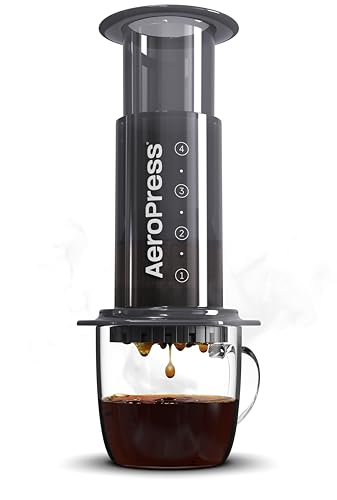
The Original is the AeroPress that everything else in the lineup is a variation on, and it has stayed largely unchanged because the design was resolved on the first attempt. A polypropylene chamber, a rubber-sealed plunger, a screw cap holding a paper disc. There is nothing to fail beyond the seal, and the seal is a stocked spare part.
What separates it from the models above it is nothing to do with coffee. The chamber diameter, the filter area and the plunger travel are shared across the standard-size range, so a recipe developed on an Original transfers unchanged to a Clear or a Premium. World AeroPress Championship recipes are written for this chamber. If a review tells you a different model tastes better, ask what mechanism would produce that difference.
Its two real limitations are both addressable. You cannot see the brew, which makes learning the inverted method slightly more nervous than it needs to be — the Clear fixes that. And water drains through the paper filter during a long steep, which inverting or a valve cap fixes. Neither is a fault in the brewer so much as a consequence of putting the filter at the bottom.
The one to buy. Twenty years of production, parts still sold, and it brews exactly what the more expensive models brew.
Check price on Amazon →#2Best for learning
AeroPress Clear Coffee Press, All-in-One French Press, Pour-Over and Espresso Style Manual Brewer, Small Portable Coffee Maker
Best for: Anyone still working out their recipe, or anyone who inverts and wants to see what they are flipping
What we like
- Tritan chamber is genuinely transparent, so the water level, the bloom and the bed are all visible
- Same shatter resistance as the Original in practice — Tritan is a tough copolyester, not glass
- Makes the inverted method far less nerve-racking because you can see how far the plunger is seated
- Shares every part and accessory with the Original, including caps and filters
- Available in tinted colours as well as clear, which are the same chamber
What we don't
- Costs more than the Original for a difference that is visual rather than functional
- Tritan scratches more visibly than polypropylene over years of stirring
- Transparency also shows every coffee stain, so it looks worse sooner unless cleaned promptly
- No capacity gain over the Original despite feeling like a step up
- Dishwasher tolerance is lower than the Original's in practice, per owner reports
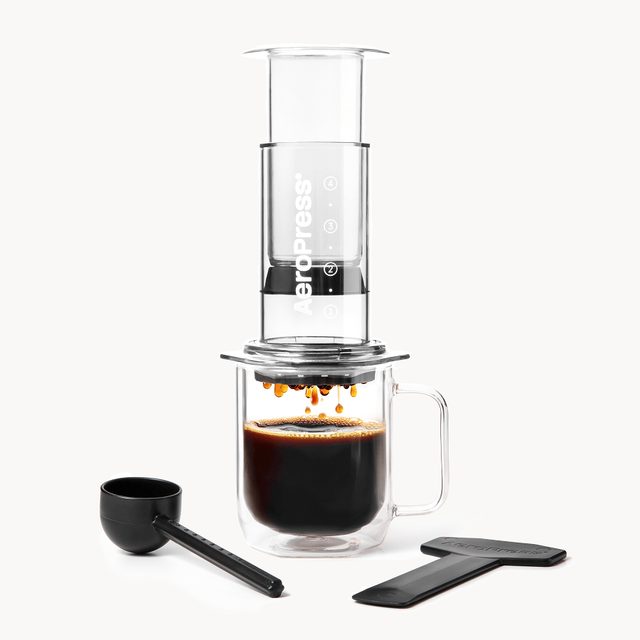
The Clear is the Original in transparent Tritan, and that one change turns out to be more useful than it sounds while you are still finding a recipe. Seeing the water level tells you immediately whether the drip-through on a two-minute steep is trivial or significant. Seeing the bed tells you whether your stir actually wetted all the coffee or left a dry clump against the wall. Both are things you otherwise infer from taste, slowly.
It is also the model that makes the inverted method reasonable to learn. The stated risk of inverting is a chamber of hot coffee coming apart mid-flip, and the actual cause is almost always a plunger that was not inserted far enough to grip. On an opaque body you find out by feel; on this one you look.
Once a recipe is fixed, the advantage largely evaporates, which is the honest case against it. Tritan is tough but it scratches, and a transparent chamber advertises staining that an opaque one hides. Buy it for the learning period and the pleasure of watching a brew, not for the coffee, which is identical.
The Original with the lid off. Worth the premium while you are learning and largely cosmetic once you are not.
Check price on Amazon →#3Best for travel
AeroPress Go Extra Small Portable Coffee Maker Kit for Travel, Hiking and Camping, All-in-One Manual Brewer
Best for: Travel, the office, camping and anywhere the brewer has to survive being packed
What we like
- The entire kit nests inside its own 15oz mug with a lid, so nothing rattles loose in a bag
- Shorter chamber and smaller footprint than the Original, genuinely luggage-sized
- Includes a folding stirrer, a scoop and a filter holder sized to the kit
- Same brewing mechanism as the Original at a reduced volume
- The mug doubles as the vessel, which removes the usual travel problem of finding something to brew into
What we don't
- Smaller chamber brews one to two cups rather than one to three — a real capacity cut, not a marketing one
- Uses the same standard filters but the shorter chamber limits how large a bypass brew you can build
- The included mug is the reason it packs well and the reason the kit is bulkier than a bare Original
- Plunger travel is shorter, so the press feels more abrupt and is easier to rush
- For home use it is a smaller Original with extra parts to store
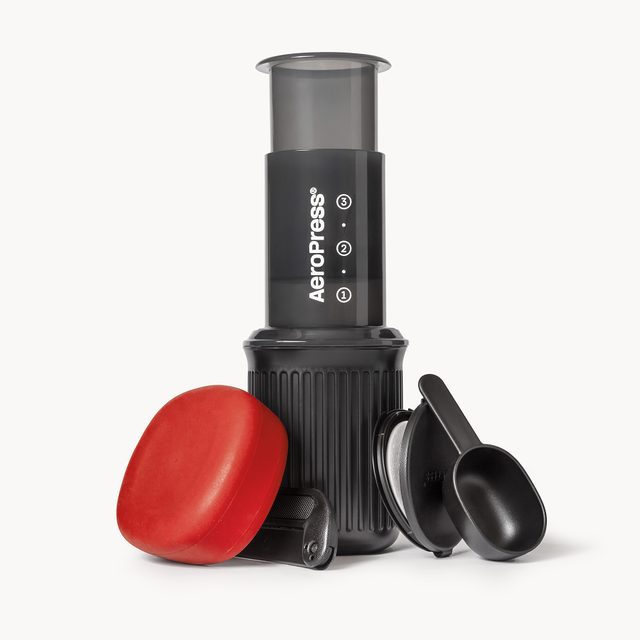
The Go is best understood as a packaging exercise rather than a brewing one. The chamber is shorter and narrower, the kit includes a mug that everything else nests inside, and the whole assembly clips shut. For a bag, a desk drawer or a tent it solves a problem the Original genuinely has — a bare AeroPress in luggage sheds its cap, loses its filters and arrives full of grit.
The capacity cut is real and worth planning around. Where the Original comfortably makes a large mug in one pass, the Go is a single normal cup, and building a bigger drink means bypass dilution rather than a bigger brew. That is a fine technique and it is covered on the pillar guide, but it is a step rather than an option.
What it does not do is brew better or worse. Owner reports converge on the same conclusion the specifications suggest: same coffee, less of it, in a package that survives being carried. If the brewer lives permanently on a kitchen counter, the Original is the better object and the Go's mug becomes something to find a cupboard for.
A travel kit rather than a smaller brewer. Excellent at that job and pointless if you never take it anywhere.
Check price on Amazon →#4Best for two
AeroPress Original XL Coffee Press, All-in-One Large French Press, Pour-Over and Espresso Style Manual Brewer
Best for: Households where two people want coffee at the same time, or anyone tired of brewing twice
What we like
- Roughly double the chamber volume, which is the only genuine capacity upgrade in the lineup
- Makes a full carafe-sized brew or two large mugs in a single pass
- Includes its own larger filter cap, filters and a carafe-friendly form
- Removes the main reason to use bypass dilution, since you can simply brew more
- Same mechanism and same press action, scaled up
What we don't
- Needs XL-specific paper filters and an XL cap — standard filters do not fit, which is easy to forget when reordering
- Physically large, and tall enough to be awkward over a short mug
- A deeper coffee bed is harder to extract evenly than a shallow one, so recipes need re-dialling rather than scaling
- The press requires noticeably more force and is less controllable at the end of travel
- Overkill for a single drinker, and the accessory ecosystem is smaller than the standard size's
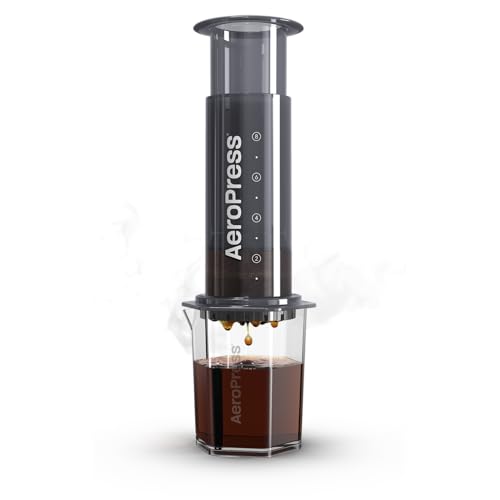
Capacity is the AeroPress's only structural weakness — one cup at a time, brewed again for the second person — and the XL is the only model that addresses it directly. Roughly twice the chamber, an XL cap and XL filters, and a single pass that fills a small carafe.
The trade is that a deeper bed behaves differently. Water has further to travel through more coffee, extraction is less even top-to-bottom, and the press needs real body weight rather than a light lean. Recipes do not scale linearly from the standard size; most owners end up slightly coarser and slightly longer than a doubled Original recipe would suggest. That is normal for any brewer that grows, and it means the XL rewards a little dialling rather than none.
The practical trap is consumables. XL paper filters are a separate product from standard ones and the caps are not interchangeable, so an XL household needs its own filter supply. Worth knowing before the first reorder rather than after.
The answer to the AeroPress's one real limitation. Buy it for volume and accept a slightly less refined press.
Check price on Amazon →#5Best built
AeroPress Premium Coffee Press, Glass, Stainless Steel and Aluminum, Silver, All-in-One Manual Brewer
Best for: A permanent kitchen station where the brewer is on display and never leaves the counter
What we like
- Double-wall borosilicate glass chamber holds temperature better than any plastic model here
- Stainless steel and aluminium fittings, and a stainless filter cap included rather than sold separately
- The only model that looks like a deliberate object on a kitchen counter
- Heat retention genuinely helps long steeps, where a cold plastic chamber costs a few degrees
- Every wear part — seal, cap, plunger — is stocked separately, same as the Original
What we don't
- Glass, so it is the one AeroPress that can actually break, which removes the model's signature advantage
- Hand-wash only by the manufacturer's instruction, unlike the plastic models
- Heaviest and least portable of the five by a wide margin
- The most expensive way to make coffee that is chemically identical to the Original's
- Aluminium and glass make it the wrong choice for travel, camping or a shared office
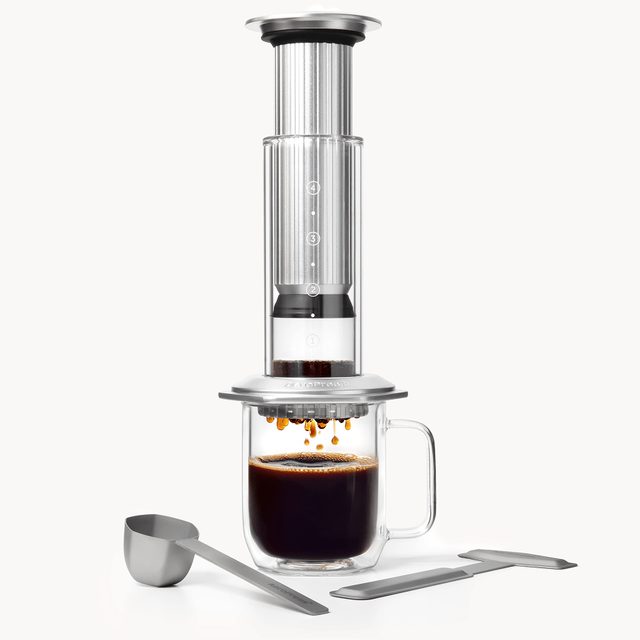
The Premium replaces the plastic chamber with double-wall borosilicate glass and the plastic fittings with steel and aluminium, and it is the only model in the lineup where a specification change plausibly touches the cup. A double-wall glass chamber loses less heat during a steep than a single-wall room-temperature plastic one, and since the AeroPress is a small volume of water in a cold body, that is not nothing — it is the same effect that makes pre-warming worthwhile on every other model.
What it gives up is the thing the AeroPress is famous for. The Original's appeal is that it does not break, packs into a bag and tolerates being treated badly. The Premium is glass, hand-wash only, and heavy. It is a counter appliance that happens to be an AeroPress rather than an AeroPress that happens to be nice.
On that basis it is a reasonable purchase for a fixed coffee station and a poor one for anything else. The included stainless filter cap is a genuine value addition rather than a flourish, since it is one of the accessories most Original owners eventually buy anyway.
The best-made AeroPress and the least AeroPress-like. Buy it for the object and the heat retention, not the coffee.
Check price on Amazon →They all make the same coffee
This is the claim that should frame everything else, so it is worth being precise about why it is true.
An AeroPress extracts by immersion and then pushes the water through a filter with hand pressure. The variables that determine what comes out are the coffee-to-water ratio, the grind, the contact time, the water temperature and the filter. The standard-size models share a chamber diameter, a filter area and a plunger, which means every one of those variables is under your control and none of them is set by the model.
So a recipe developed on an Original transfers to a Clear or a Premium unchanged. World AeroPress Championship recipes are written for this chamber and used on whichever body the competitor happens to own.
The one exception is small and physical rather than mechanical: the Premium’s double-wall glass loses less heat during a steep than a room-temperature plastic chamber. That is a real effect, and pre-warming any model with hot water recovers most of it for free.
Capacity is the only spec that changes what you can make
The genuine functional difference in the lineup is volume, and it splits three ways.
The standard chamber — Original, Clear, Premium — brews one to three cups depending on how strong you want them, which in practice means one generous mug or two small ones.
The Go is smaller. One to two cups, and building a larger drink means brewing a concentrate and diluting it in the cup rather than brewing more.
The XL is roughly double, and it is the only model that lets two people have coffee at the same time from one brew. That sounds minor until you have brewed twice every morning for a month, which is how most AeroPress households discover the limitation.
A deeper bed does extract slightly less evenly, so XL recipes need re-dialling rather than doubling — usually a touch coarser and a touch longer than arithmetic suggests.
What the materials actually change
Three chamber materials, and the differences are not the ones the marketing emphasises.
Polypropylene — the Original and the Go. Effectively unbreakable, opaque, and cheap enough that the brewer is not something you worry about. Stains faintly over years.
Tritan — the Clear. A tough copolyester, not glass. It survives impact about as well as polypropylene and scratches more visibly. What it buys is transparency, which is genuinely useful while learning and cosmetic afterwards.
Borosilicate glass with steel and aluminium — the Premium. Better heat retention, much better looking, and the only model that can break. It also becomes hand-wash-only, which is a real change in how it fits into a kitchen.
Note what is missing from that list: none of these materials changes extraction. A plastic chamber and a glass one hold the same coffee against the same filter.
The Go is a travel kit, not a small AeroPress
Worth separating because the naming invites the wrong conclusion.
The Go’s value is that the filter holder, the stirrer, the scoop and the cap all nest inside a mug that clips shut. Anyone who has carried a bare AeroPress in luggage knows the problem it solves — the cap unscrews, the filters scatter, and the chamber arrives full of whatever else was in the bag.
What it is not is a better small brewer. At home the capacity cut is a straightforward loss and the mug is an extra object to store. If it will not be carried, the Original is the better purchase.
What the Premium is for
The Premium inverts the AeroPress’s usual proposition. Instead of a cheap, indestructible tool you do not think about, it is a considered object you keep on display — glass, steel, aluminium, hand-wash only, heavy.
That is a legitimate thing to want, and the heat retention is a genuine if modest benefit for long steeps. It is also the model that abandons the two features most people would name as the AeroPress’s best: it can break, and it is awkward to carry.
Buy it for a fixed coffee station. Do not buy it as your only AeroPress if it will ever go anywhere.
Which one to buy
Brewing one cup, at home, still learning the recipe — the Clear. Watching the brew is worth more during the first month than it is afterwards.
Brewing one cup, at home, recipe settled — the Original. Cheapest, toughest, best supported, same coffee.
Carrying it — the Go, and accept the smaller chamber.
Two people, same time, every day — the XL, and buy XL filters at the same time.
A permanent station where it will be looked at — the Premium.
And if the choice is between a more expensive model and a burr grinder, buy the grinder. An Original with freshly and evenly ground coffee beats a Premium filled with pre-ground beans by a margin no chamber material can close — the same conclusion that holds across every method on this site, and one a hand grinder satisfies perfectly well for a single cup.
The accessories that do change the brewing — metal filters, flow-control and pressure-valve caps — are covered in AeroPress filters and accessories.
For how to actually use whichever one you buy, including whether the inverted method is worth the risk, see AeroPress brewing: standard, inverted and bypass explained.
Frequently asked questions
Do the different AeroPress models make different coffee?
No, and this is the most important thing to know before comparing them. The standard-size models — Original, Clear, Go and Premium — share the chamber diameter, the seal design, the filter area and the plunger mechanism, so the same recipe produces the same result in all of them. The XL differs only in scale, and even there the mechanism is the same. The Premium's double-wall glass retains heat slightly better than a cold plastic chamber, which is a real but small effect that pre-warming largely replicates on any model. Capacity, material and portability are the genuine differences.
Which AeroPress should I buy first?
The Original, unless you have a specific reason not to. It is the cheapest, the most durable, the best supported for parts, and it brews what every other model brews. Buy the Clear instead if you would find watching the brew useful while learning, the Go if it will be carried regularly, the XL if two people want coffee simultaneously, and the Premium if it will live permanently on a counter and you want an object rather than a tool.
Is the AeroPress Go worth it over the Original?
For travel, yes; for home, no. The Go's value is entirely in its packaging — the whole kit nests inside its own mug and clips shut, which solves the real problem of carrying an AeroPress in a bag. What you pay for that is capacity: it brews one to two cups where the Original brews one to three. If the brewer never leaves your kitchen, the Go is a smaller Original with an extra mug to store.
Does the XL use the same filters as the Original?
No, and this catches people out. The XL has a larger chamber, a larger filter cap and its own XL-sized paper filters, none of which are interchangeable with the standard size. If you own both an XL and a standard model you are maintaining two separate filter supplies. Metal filters are also size-specific. Check the size on the packet when reordering rather than assuming.
Is the AeroPress Premium's glass chamber a problem?
It depends entirely on where it lives. Borosilicate glass tolerates thermal shock well, so pouring hot water in is not the risk — impact is. The Original's defining feature is that it survives being dropped, packed and knocked about, and the Premium does not. On a fixed kitchen counter that never matters and the heat retention is a genuine small benefit. In a bag, at a campsite or in a shared office it is the wrong choice.
How long does an AeroPress last, and what fails first?
The seal, and it is the only part that wears out in normal use. The rubber plunger seal gradually loses its grip and starts to let air or water past, usually after several years, and it is sold as a spare for every model in the lineup. Chambers themselves rarely fail on the plastic models. Because every wear part is stocked separately, an AeroPress is a repairable object rather than a disposable one, which is a meaningful part of the case for buying one at all.
Can I put an AeroPress in the dishwasher?
The plastic models tolerate a top rack reasonably well, though owner reports suggest repeated hot cycles accelerate seal hardening and cause visible clouding on the Clear's Tritan. The Premium is hand-wash only by the manufacturer's instruction. In practice none of them need it — the used puck ejects as a dry disc and the chamber rinses clean in seconds, which is the whole reason the AeroPress is easier to live with than a French press.
Should I buy a model with accessories included or buy them separately?
Buy the brewer you want and add accessories deliberately. The bundled scoop and stirrer are the two things nearly every owner stops using, because a scale replaces the scoop and any spoon replaces the stirrer. The accessories that genuinely change AeroPress brewing are a metal or flow-control filter cap and a scale, and neither comes in the standard boxes except on the Premium, which includes a stainless cap.